• What we do

    full-cycleFull Cycle Developmentstaff-augmentationIT Staff Augmentationai-developmentAI DevelopmententerpriseEnterprise Application Developmenttech-consultingTechnology Consulting
    Service Preview
    full-cycle
    Service preview

    Full Cycle Development

    End-to-end software development from concept to deployment, using cutting-edge technologies and best practices.

    Learn more
  • Blog
    In-House Software Development VS Outsourcing: Strategic Guide for 2026The DeviLLM Bargain: Gain Superhuman Speed… But Can You Handle the Risk?The JavaScript Diet: 33% Bloat Loss.Pretty Lies or Ugly Truths? Debunking 10 Software MythsIs SaaS Dead? Rethinking Software's Role
    Company News
    Process Monitoring Events - Version 4.1 Official LaunchScientific Paper: Refinement of the Cauchy-Schwartz inequalityTensorial Simpson Type Inequalities of Self Adjoint Operators in Hilbert SpaceGeneralization of the Buzano's Inequality and Numerical RadiusNew Partnership with HomeStory Rewards Corporation
    Case Studies
    Operations, Synced: End-to-End Live Process Monitoring Meetings, Transformed: Gesture-Led WorkspaceFrom Static to Addictive: Content Exchange PlatformOne Hub. Unified Fintech Control.The New Blueprint: AI-Driven Mortgage Engagement
    Featured resource
    Featured article

    Operations, Synced: End-to-End Live Process Monitoring

    Integrated disconnected tools and data sources to deliver real-time operational insight for a 200+-employee SaaS, IoT, and FinTech enterprise.

    Read more
    See all case studies
  • About Us
  • FAQ
Get Started

We deliver advantage beyond features.
What will you ship?

Get Started
  • Full Cycle Development
  • IT Staff Augmentation
  • AI Development
  • Enterprise Application Development
  • Technology Consulting
  • Case Studies
  • Blog
  • Company news
  • About
  • FAQ
  • Contact Us

Follow Us

Site MapTerms of UsePrivacy Policy
© Energmа 2026. All rights reserved.
Železnička 94, 11300 Smederevo, Serbia
Article thumbnail

Is SaaS Dead? Rethinking Software's Role

In December 2024, Microsoft CEO Satya Nadella dropped a bombshell, challenging the very foundation of the Software as a Service (SaaS) model. He claimed on a BG2 podcast that agentic AI would replace the business apps that built the last two decades of tech fortunes.

The statement split the industry. And every CTO was left staring at the same questions: What if SaaS really is over? What comes next?

Founders panicked. Developers cheered. Investors scrambled.

And every CTO was left staring at the same questions:

What if SaaS really is over? What comes next?

In this article, we'll delve into this explosive prediction, analyze whether it holds any truth, and explore how tech leaders can adapt before it's too late.

Quick Summary

  • SaaS growth has slowed from 50%+ to 20%, signaling a structural shift.
  • Product-led growth is losing its shine, with buyers burned by overpromises.
  • Agentic AI is emerging as the new operating layer, driving end-to-end automation and siphoning budgets away from SaaS.
  • Founders now face a choice: keep selling tools or use software as leverage to transform their own businesses.
  • Venture capital is chasing AI-driven startups, leaving "pure" SaaS to prove fundamentals.

The Rise and Fall of SaaS Dream: Too Good to be True?

For over a decade, SaaS was worshipped as the holy grail of software business models. Recurring revenue. Infinite scalability. Predictable customer lifetime values (LTVs). Investors and entrepreneurs couldn't get enough. However, industry insiders are now questioning whether this model has lived up to its lofty expectations.

One of the primary criticisms against SaaS is the misconception of infinite LTVs. It's a fantasy that once a customer is acquired, they will continue to pay indefinitely. In reality, businesses face continuous pricing pressures and competitive threats, making customer retention an ongoing challenge.
Blog image

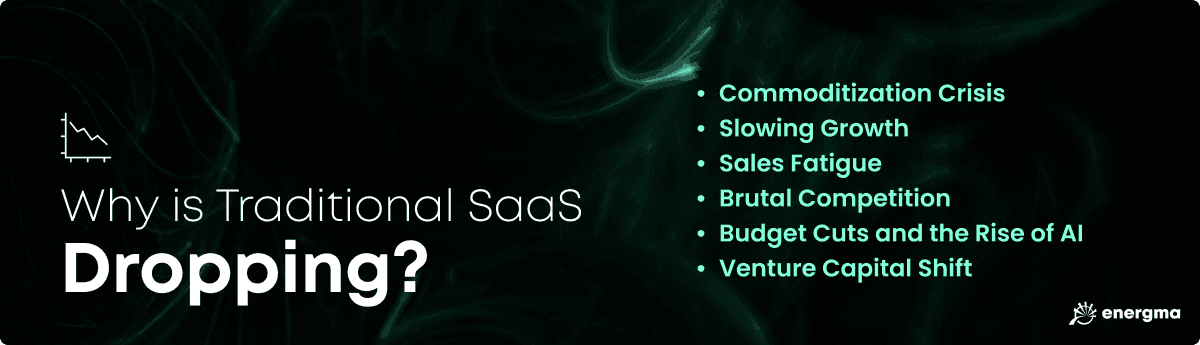
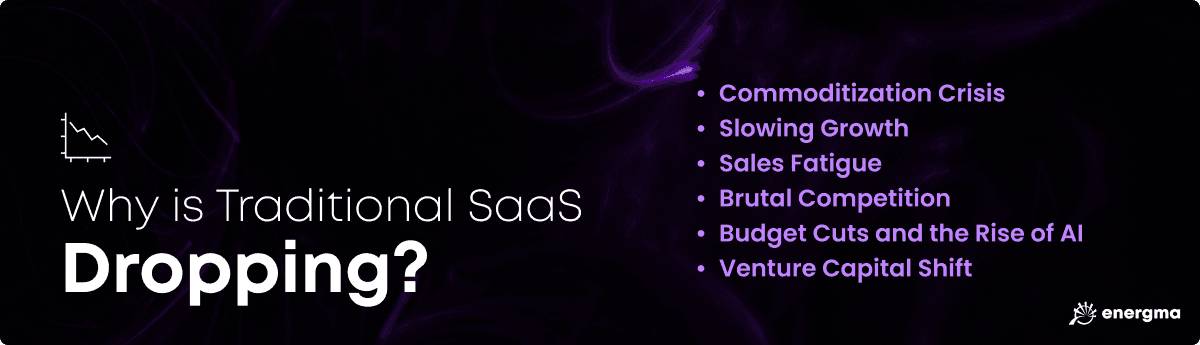
Why is Traditional SaaS Dropping?

The decline of the traditional SaaS model is attributed to several interconnected factors, all reshaping the landscape we knew.

SaaS Commoditization Crisis

What used to be proprietary gold, the code itself, has become increasingly easy to replicate. With the rise of AI and more accessible development tools, the barriers to entry have lowered significantly. Startups can now launch feature-rich products with fewer resources than before, flooding the market with alternatives that look and feel similar.

As software creation has become easier and when everything looks alike, value collapses. Platforms that once felt essential are now brushed off as "nice-to-haves". Customers are demanding not just more features, but demonstrable ROI.

Slowing Growth

Public SaaS companies, which enjoyed growth rates of 40% to 50% or more annually, are now experiencing a modest reality. Most are hovering below 20% growth year-over-year.

This decline is not just a blip. It's a structural shift. The market becomes saturated. Customers become savvier. The hypergrowth that looked effortless a decade ago has become an uphill battle.

Moreover, the revenue generated from SaaS sales often falls short of the value it creates. That gap bleeds margins, disappoints investors and presents a significant challenge in profitability and scalability.

Sales Fatigue

Product-Led Growth (PLG) has been a buzzword in SaaS for years, with companies like Slack and Zoom becoming symbols for its success. The concept is simple: let your product sell itself. While this works well for highly viral or consumer-friendly products, it's been a struggle for many B2B SaaS startups, where enterprise sales cycles are long and complex.

Gone are the days when a slick demo sealed the deal. Buyers have been burned after years of overpromises and underdeliveries. Even for companies with impressive software and margin-expanding stories, closing deals remains difficult without a clear and compelling value proposition.

Brutal Competition

Technological advances have made it easier than ever to launch a SaaS product.

Low-code, no-code tools and AI-assisted development allowed new competitors to emerge virtually overnight. Standing out in such a crowded marketplace demands great technology, brand differentiation, and exceptional customer experience.

Budget Cuts and the Rise of AI

AI has exploded and companies are reallocating their budgets. Traditional SaaS subscriptions are under intense audit and funds are flowing toward AI tools that promise greater productivity gains. Vendors can no longer hide behind features. Every dollar must be justified with tangible, measurable outcomes.

Venture Capital Shift

Venture capitalists used to pour money into any SaaS venture with even a hint of promise, half-decent deck and a dream of ARR. Not anymore.

Today, the spotlight and the checks are aimed at AI-driven startups. This redirection of capital means that fundraising for "pure" SaaS companies has become more competitive, forcing founders to build real businesses with strong fundamentals earlier in their journey.

A New Angle: Software as a Business Weapon

So where does this leave us?

Instead of focusing solely on software subscriptions, innovative companies are using software to enhance and transform existing businesses' operations by 20-30% or more. By creating such powerful tools, tech companies can position themselves to acquire or partner with the businesses they've enhanced, thereby capturing a larger share of the value they've created.

For example, look at Klarna. Their decision to sever ties with enterprise SaaS providers like Salesforce and Workday is a hallmark of this shift. Rather than paying for external solutions, Klarna is building its own AI-powered tools to streamline operations. From the outside, it looks like saving pennies, but it's much more strategic than that. Klarna is using its internal software to gain a competitive advantage, reduce dependencies on third-party vendors, and ultimately control its own destiny.

For founders, this flips the script. Instead of trying to sell software to other companies, use your software to improve businesses you own or operate. The real value isn't in the software itself, but how that software transforms a business to be faster, efficient, and more profitable.

From an investor's perspective, this is even more appealing. Rather than backing the 100th SaaS startup hoping to scale through subscriptions, investors look for businesses using tech to disrupt and dominate entire industries. The risk is lower because these companies aren't selling commoditized software. They're using it to gain an edge in markets with real, tangible value.

The Strategy in Action

Picture this: tech company develops an AI-powered inventory management system that dramatically improves efficiency for retailers. Instead of selling this system as a SaaS product, the company could use it as leverage to acquire successful retail operations. By implementing their proprietary software, they could significantly boost the profitability of retailers, creating value far beyond what they might have captured through traditional software licensing.

This allows tech companies to benefit from margin expansion, operational improvements, and competitive advantages in industries that might have previously seemed unrelated to their core competencies. It's a way of using software not just as a product, but as a means to enter and dominate entire sectors of the economy.

For example, we've been pushing the same strategy with Tazz, an agentic AI team of developers under senior software engineers. While we create intelligent systems, they are writing other parts of the software (currently well beyond 300,000 lines of code). Every piece is iterated through AI-powered QA to filter which can be used and implemented further in the development process.

Tazz doesn't just write code. It maps business scenarios through tested end-to-end frameworks and frees our human engineers to focus on what actually brings value, without worrying if any existing functionality has been broken.

The Future of Software in Business

As we look to the future, it's clear that software will continue to play a crucial role in business success. The role shifts from product to the edge that lets businesses outpace, outmaneuver, and dominate various industries.

It doesn't mean that all SaaS companies will disappear overnight. Many will continue to thrive, especially those providing essential services or niche players. But the bigger prize? It belongs to ambitious tech entrepreneurs and investors who treat software not as the finish line, but as the weapon to capture something far greater.

Agentic AI is the new frontier. One where automation works end-to-end, across functions, and where businesses only pay for outcomes delivered. Enterprises that recognize this will see clear rewards. Greater efficiency. Tangible RoI. A new era of intelligent, autonomous automation. No more seat-based, fragmented tools that end up creating more complexity than they solve.

Final Thoughts

The lesson from history is clear. Technological revolutions are rarely binary and don't typically lead to total replacement. Instead, they create convergent ecosystems where AI and SaaS will complement and compete in various ways.

Cloud computing was supposed to replace on-premises systems, but hybrid models have become the norm. Businesses now balance cloud and on-premises architectures to optimize flexibility, control, compliance, security, and cost. Perhaps my favorite example is the humble PC. Mobile phones, tablets, and other devices were foreshadowed as its "death". Yet here I am, typing this blog post on a laptop. PCs remain the most essential devices for productivity-focused tasks, coexisting alongside them.

SaaS isn't dead. But the old playbook is buried — the one that relied on simply building a decent product, slapping on a subscription price, and expecting a steady stream of customers without ongoing strategic innovation.

In today's hyper-competitive environment, just having a "good enough" product no longer cuts it. SaaS is undergoing a profound transformation, and those who fail to evolve are being ruthlessly left behind.

Table of Contents

  • The Rise and Fall of SaaS Dream: Too Good to be True?
  • Why is Traditional SaaS Dropping?
    • SaaS Commoditization Crisis
    • Slowing Growth
    • Sales Fatigue
    • Brutal Competition
    • Budget Cuts and the Rise of AI
    • Venture Capital Shift
  • A New Angle: Software as a Business Weapon
  • The Strategy in Action
  • The Future of Software in Business
  • Final Thoughts