
• What we do

    full-cycleFull Cycle Developmentstaff-augmentationIT Staff Augmentationai-developmentAI DevelopmententerpriseEnterprise Application Developmenttech-consultingTechnology Consulting
    Service Preview
    full-cycle
    Service preview

    Full Cycle Development

    End-to-end software development from concept to deployment, using cutting-edge technologies and best practices.

    Learn more
  • Blog
    In-House Software Development VS Outsourcing: Strategic Guide for 2026The DeviLLM Bargain: Gain Superhuman Speed… But Can You Handle the Risk?The JavaScript Diet: 33% Bloat Loss.Pretty Lies or Ugly Truths? Debunking 10 Software MythsIs SaaS Dead? Rethinking Software's Role
    Company News
    Process Monitoring Events - Version 4.1 Official LaunchScientific Paper: Refinement of the Cauchy-Schwartz inequalityTensorial Simpson Type Inequalities of Self Adjoint Operators in Hilbert SpaceGeneralization of the Buzano's Inequality and Numerical RadiusNew Partnership with HomeStory Rewards Corporation
    Case Studies
    Operations, Synced: End-to-End Live Process Monitoring Meetings, Transformed: Gesture-Led WorkspaceFrom Static to Addictive: Content Exchange PlatformOne Hub. Unified Fintech Control.The New Blueprint: AI-Driven Mortgage Engagement
    Featured resource
    Featured article

    Operations, Synced: End-to-End Live Process Monitoring

    Integrated disconnected tools and data sources to deliver real-time operational insight for a 200+-employee SaaS, IoT, and FinTech enterprise.

    Read more
    See all case studies
  • About Us
  • FAQ
Get Started

We deliver advantage beyond features.
What will you ship?

Get Started
  • Full Cycle Development
  • IT Staff Augmentation
  • AI Development
  • Enterprise Application Development
  • Technology Consulting
  • Case Studies
  • Blog
  • Company news
  • About
  • FAQ
  • Contact Us

Follow Us

Site MapTerms of UsePrivacy Policy
© Energmа 2026. All rights reserved.
Železnička 94, 11300 Smederevo, Serbia
Article thumbnail

In-House Software Development VS Outsourcing: Between a Rock and a Hard Place (Strategic Decision Guide for 2026)

The "build vs. buy" question is a rite of passage for every scaling tech leader. As a strategic inflection point that will dictate a company's agility, overhead, and innovation velocity for years to come, it's one of the most critical decisions in today's digital landscape. Get it wrong, and you'll face bloated costs and painful delays. Get it right, and you unlock a scalable competitive advantage. After working with 30+ companies to navigate this choice, we've compiled the data, hard numbers and lessons learned into this definitive guide. Let's dive in.

Quick Summary

  • In-house development offers maximum control and cultural cohesion but at a high, fixed cost and with slower scalability. Outsourcing offers speed, flexibility, and access to a global talent pool but requires you to manage communication and mitigate security risks.
  • An in-house employee's total cost can be up to 2.7x their base salary when you factor in recruitment, benefits, office space, and management overhead, creating significant financial rigidity.
  • Outsourcing can dramatically accelerate your time-to-market. While in-house projects take an average of one year, an outsourced team can be assembled and start delivering in weeks, allowing you to outpace competitors stalled by hiring.
  • Concerns about communication, security, and control are valid, but they are not inherent flaws. They are eliminated by choosing the right partner—one with robust processes, certifications (like ISO 27001), and a model designed for integration.
  • The hybrid model is the modern solution. The most effective strategy is often a blend: a core in-house team to protect your mission-critical IP and culture, combined with outsourced experts to provide specialized skills and elastic scaling. This approach delivers both control and agility.

Difference between In-House vs Outsourcing Software Development

Let’s begin our in-house vs outsourcing comparison with explaining the terms:

  • In-house software development means a company develops software internally. Full-time developers work per fixed salary under direct company management, focusing exclusively on the product.
  • Conversely, outsourcing refers to the transfer of specific software development tasks or projects to external parties or service providers. It’s actively used by companies without expertise and/or resources to build software themselves.

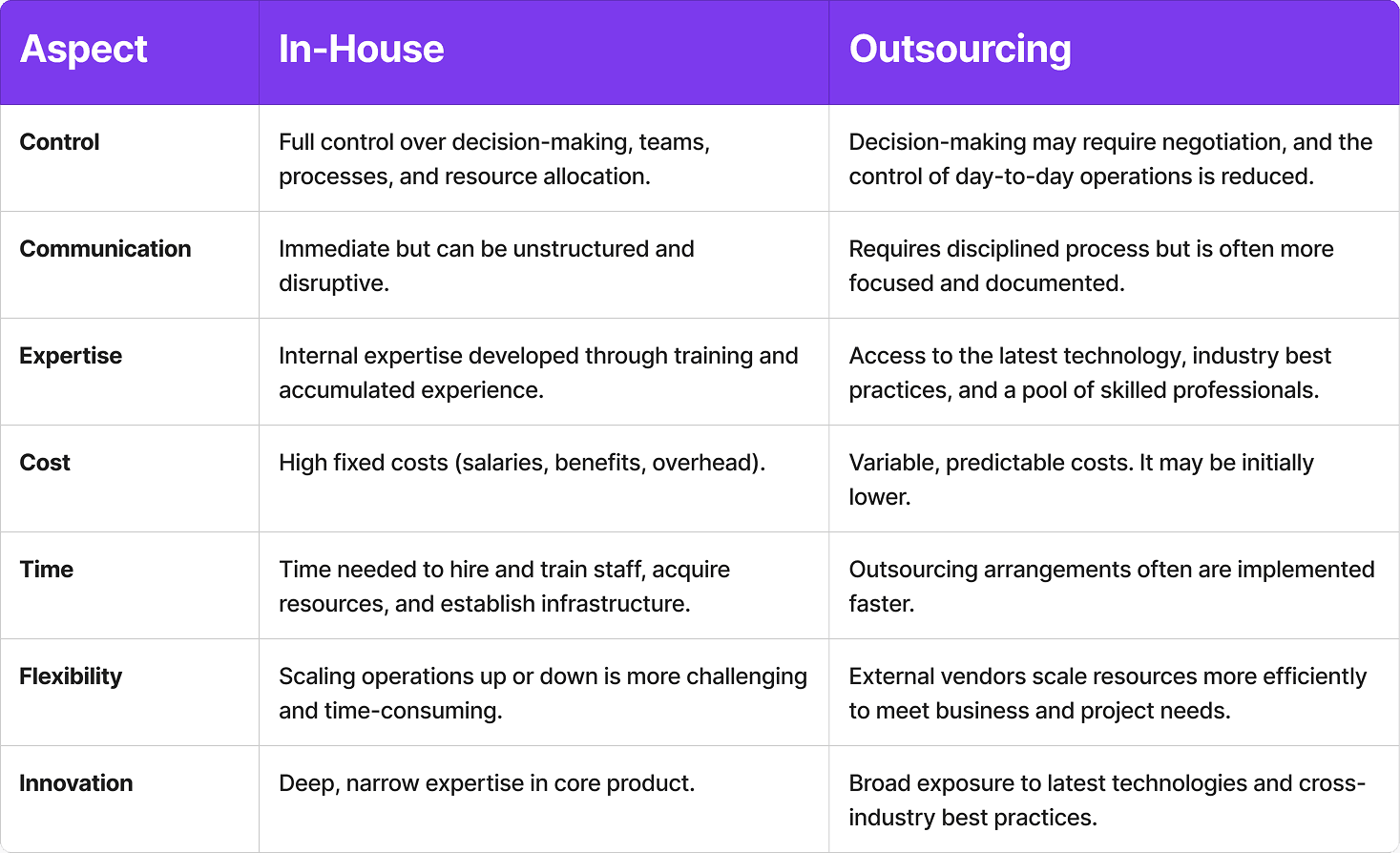
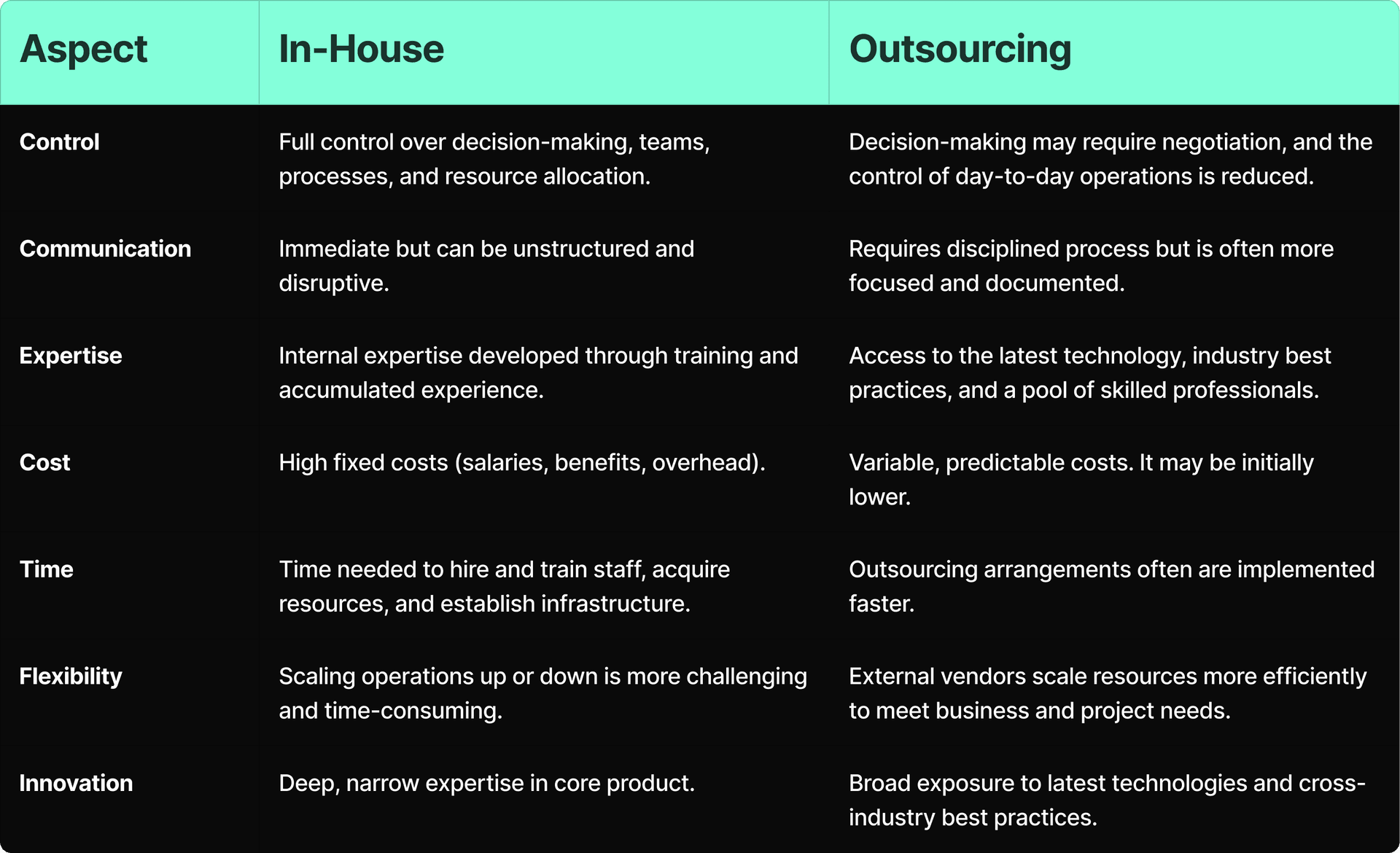
This table will help you better understand in-house vs outsourcing pros and cons:
Blog image

Now that you are familiar with both concepts, let’s examine the in-house and outsourcing pros and cons in detail.

Benefits of Outsourcing Software Development

One thing is indisputable. This is the biggest industry in the world. Forecasts project that by the end of the year the revenue will reach an impressive figure of US$742.58B, according to Statista. While distributing some of the work to external service providers, companies enable focus on core competencies and eliminate repetitive tasks. But that's just a piece of the puzzle. Some of the key pros are:

Flexibility to Scale

You can ramp up or down your team based on the project requirements. There’s no need to hire or fire. It is especially useful for companies that experience seasonal fluctuations in demand or need to accommodate a sudden increase in workload.

Cost Savings

Outsourcing is often more cost effective than hiring full-time staff. You save on labor costs, office space, and employee benefits. This frees up significant capital for core innovation.

Global Talent Pool

You’re not limited by location. By gaining immediate access to niche expertise (e.g., AI, blockchain) that are simply unavailable or unaffordable locally, you can find the right person or team for the job – faster.

Faster Time to Market

Since outsourced development teams are usually experienced and ready to go, your product can hit the market faster. This isn't just about speed. It's the ability to seize market opportunities and outpace competitors who are slowed down by recruitment and onboarding.

Tried and proven delivery processes

Outsourcing companies usually have multiple projects and experience in different areas of development. Thus, they have expertise in product delivery, a huge advantage for any company that decides to outsource its development. Additionally, outsourcing vendors often have access to tools and technologies that may not be available to in-house teams.

Focus on Core Business

Outsourcing allows your internal team to focus on what matters most – your core business.

Disadvantages of Software Development Outsourcing

Here are some cons of outsourcing to keep in mind:

Communication Issues

Working with outsourced teams in different time zones may lead to delays or misunderstandings, especially if there are language barriers. Choosing the right partner who operates on overlapping hours, uses your communication tools and provides a single point of contact who speaks your language, literally and technically, will make or break the product.

Security and Privacy Concerns

Handing over sensitive data to a third party raises security risks and is the No.1 concern for leaders. Mitigating it is non-negotiable and requires a partner with ISO 27001 certification, robust NDAs, and a proven track record in your industry.

Less Control

You have less say in the daily workings of your development process. Depending on the outsourcing model, this could affect quality. However, this is more a risk of delegation, not outsourcing. By agreeing on weekly syncs, and establishing clear ownership charts, you maintain strategic control.

Benefits of In-House Software Development

Now that we’ve covered all the nuances associated with outsourcing, it’s time to explore an alternative approach – in-house development. It has quite a few benefits that are just as relevant today as they were in the pre-outsourcing days:

Efficient Communication

Face-to-face communication eliminates many problems that might arise with outsourced teams and can boost productivity. The chance of misunderstandings is decreased as a result of more effective teamwork.

Direct Control

You have direct control over the development. Your team works under your supervision, follows your processes, and adapts to your business needs. Having your own staff means less risk when it comes to intellectual property and project direction. While having control over the development process can be beneficial, it can also lead to rigid processes and decision-making, which can have a negative impact on the development process.

Accumulated Knowledge

In-house software development means accumulating knowledge and expertise within an organization. Over time, the in-house team can develop a deep understanding of the company’s processes, systems, and culture, leading to more efficient development and a better product. While having employees with specialized knowledge and expertise is beneficial for the company, it can also limit the company’s ability to adapt to changes in the market or technology. That can result in a lack of diversity in the development process, leading to limited innovation and reduced competitiveness in the industry.

Cultural Fit

An in-house development team is often more connected to your company’s values and mission. This cultural fit helps reduce misalignment and keeps your team focused on long-term goals.

Disadvantages of In-House Software Development

Of course, if in-house development were the ideal solution, outsourcing wouldn’t be as popular as it is now. Here’s a rundown of some of the biggest problems:

Team Scaling Difficulties

Scaling the team can also be challenging for the in-house team, especially if the company experiences sudden growth or needs to adapt to market changes quickly. It can result in a mismatch between the company’s needs and the resources available, leading to inefficiencies and delays in the development process. This aspect is not so important in large companies that lead several projects simultaneously, as you can relocate people between these projects. But scaling your team up and down becomes critical if you are a startup or a small/midsize business.

Higher Costs

Having an entire team of the best people in the industry can be a tempting prospect, but the true cost of an in-house employee can reach 2.7x their base salary when you factor in recruitment, benefits, office space, and management overhead. When the team idles between projects, you’ll still have to cover their fixed salaries.

Limited Talent Pool

You're restricted to hiring locally or convincing candidates to relocate. That limits your access to a wide talent pool compared to outsourcing. On average, it takes 40 days to recruit in-house developers and you have to take recruitment-based expenses. That can make it difficult for companies to find and retain employees with the right skills and experience in their team, which can negatively impact the quality and efficiency of their development projects.

Slower Time to Market

In-house software development can take longer than expected. With staff members at full capacity, developers may need to double up on projects and work overtime to keep up with demand. According to QSM, the average development project takes about one year and requires 11,415 hours of effort. But companies must release their products rapidly to the market in today's cutthroat business environment or risk losing out to rivals.

And the Winner is…

The winner isn't in-house or outsourcing. The winner is the leader who makes an informed strategic choice. However, the most forward-thinking leaders are realizing the debate itself is outdated. The true winner is often a hybrid model. This strategy allows you to build a core in-house team to guard your culture and mission-critical intellectual property, while partnering with external experts to inject scalability, specialized skills, and accelerated velocity into your projects. You're no longer choosing between control and agility. You're architecting a system that delivers both.

What’s our advice?

Consider hiring people in-house if:

  • Software development is the core of your business
  • Close relations between team members are important to you
  • You foresee a stable level of work and task loads
  • There are plenty of developers in your area
  • You have a large budget
  • You’re not in a rush

Consider contracting an external provider if:

  • Software development isn’t the core of your business
  • Your workload is unpredictable or fluctuates a lot
  • It’s difficult to find developers in your area
  • You’re looking for expertise in the field
  • You have a limited budget
  • Speed is key

Most importantly, consider a Hybrid Model if:

  • You need to move faster than your current hiring cycle allows
  • Your roadmap requires specialized skills for specific, time-bound initiatives
  • Your growth is unpredictable, and you need to scale your capacity up and down without the trauma of hiring and firing
  • You want to maintain strategic control but lack the bandwidth to execute everything internally

Conclusion

While both models are having significant pros and cons, the decision ultimately boils down to one question: Is your core competency building software, or building a company? If it's the latter, the right partner isn't a vendor; they're a strategic force multiplier that enables the hybrid approach, giving you the ultimate flexibility to win every stage of the project development.

Table of Contents

  • Difference between In-House vs Outsourcing Software Development
  • Benefits of Outsourcing Software Development
    • Flexibility to Scale
    • Cost Savings
    • Global Talent Pool
    • Faster Time to Market
    • Tried and proven delivery processes
    • Focus on Core Business
  • Disadvantages of Software Development Outsourcing
    • Communication Issues
    • Security and Privacy Concerns
    • Less Control
  • Benefits of In-House Software Development
    • Efficient Communication
    • Direct Control
    • Accumulated Knowledge
    • Cultural Fit
  • Disadvantages of In-House Software Development
    • Team Scaling Difficulties
    • Higher Costs
    • Limited Talent Pool
    • Slower Time to Market
  • And the Winner is…
  • What’s our advice?
  • Conclusion