

• What we do

    full-cycleFull Cycle Developmentstaff-augmentationIT Staff Augmentationai-developmentAI DevelopmententerpriseEnterprise Application Developmenttech-consultingTechnology Consulting
    Service Preview
    full-cycle
    Service preview

    Full Cycle Development

    End-to-end software development from concept to deployment, using cutting-edge technologies and best practices.

    Learn more
  • Blog
    In-House Software Development VS Outsourcing: Strategic Guide for 2026The DeviLLM Bargain: Gain Superhuman Speed… But Can You Handle the Risk?The JavaScript Diet: 33% Bloat Loss.Pretty Lies or Ugly Truths? Debunking 10 Software MythsIs SaaS Dead? Rethinking Software's Role
    Company News
    Process Monitoring Events - Version 4.1 Official LaunchScientific Paper: Refinement of the Cauchy-Schwartz inequalityTensorial Simpson Type Inequalities of Self Adjoint Operators in Hilbert SpaceGeneralization of the Buzano's Inequality and Numerical RadiusNew Partnership with HomeStory Rewards Corporation
    Case Studies
    Operations, Synced: End-to-End Live Process Monitoring Meetings, Transformed: Gesture-Led WorkspaceFrom Static to Addictive: Content Exchange PlatformOne Hub. Unified Fintech Control.The New Blueprint: AI-Driven Mortgage Engagement
    Featured resource
    Featured article

    Operations, Synced: End-to-End Live Process Monitoring

    Integrated disconnected tools and data sources to deliver real-time operational insight for a 200+-employee SaaS, IoT, and FinTech enterprise.

    Read more
    See all case studies
  • About Us
  • FAQ
Get Started

We deliver advantage beyond features.
What will you ship?

Get Started
  • Full Cycle Development
  • IT Staff Augmentation
  • AI Development
  • Enterprise Application Development
  • Technology Consulting
  • Case Studies
  • Blog
  • Company news
  • About
  • FAQ
  • Contact Us

Follow Us

Site MapTerms of UsePrivacy Policy
© Energmа 2026. All rights reserved.
Železnička 94, 11300 Smederevo, Serbia
Article thumbnail

Top 15 KPIs That Keep Software Project on Track

In today’s fast-paced landscape of software development, Key Performance Indicators (KPIs) serve as vital signposts that guide teams through the complexities of project management, enabling them to assess their performance and make informed decisions. For years, development was seen as a black box with too many moving parts and too little visibility between input and output.

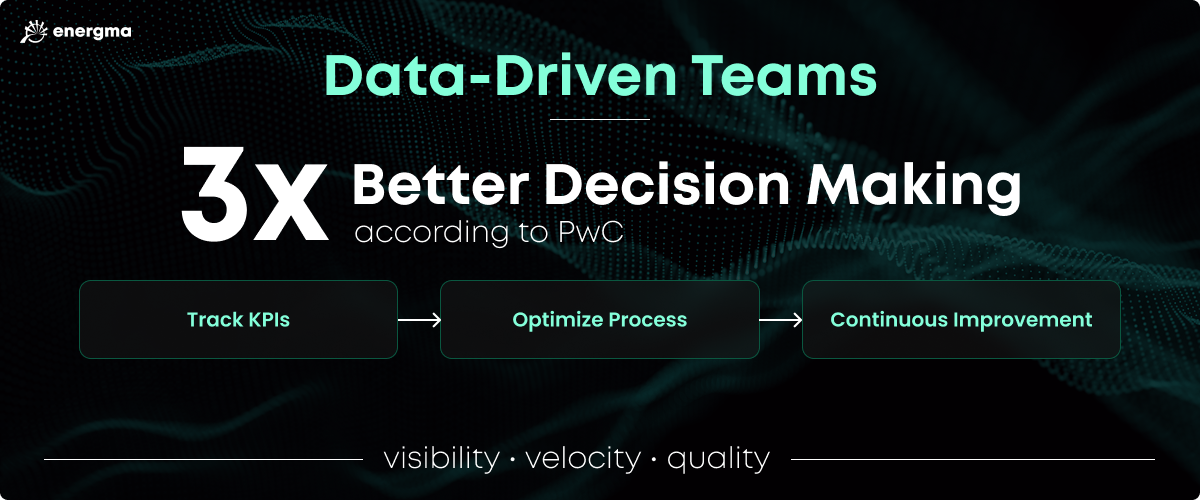
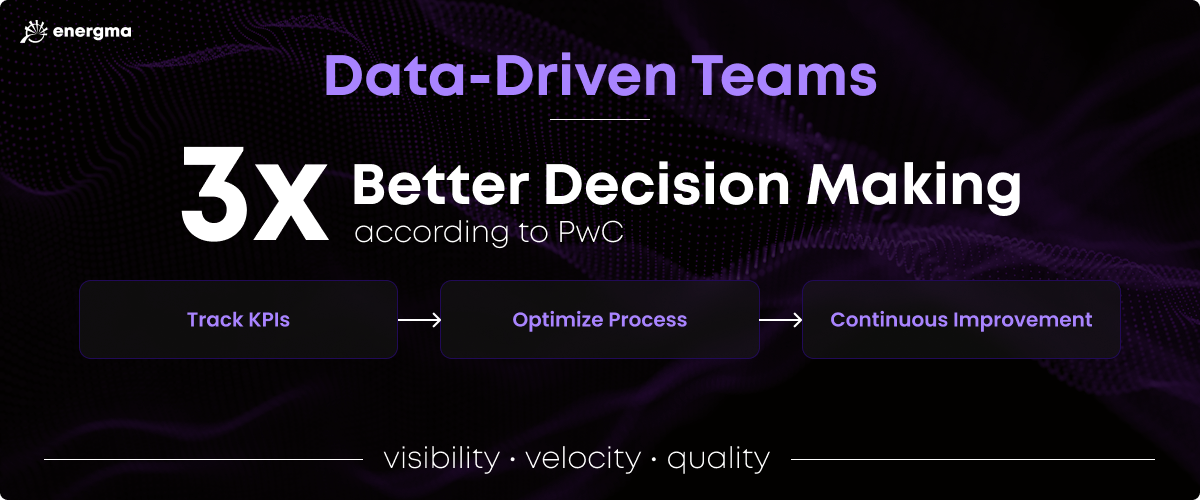
And in a world where every company now competes as a software company, that mindset is obsolete. Modern engineering leaders know the only way to align developer effort with business outcomes is through clear, data-driven KPIs. According to PwC, data-driven organizations are three times more likely to improve their decision-making.

When teams track the right metrics, they create a continuous feedback loop that drives measurable progress. They push developers to work smarter, not harder, and create a culture of continuous improvement. In this article, we’ve compiled 15 software development KPIs that keep projects on track, teams accountable, and goals measurable.

Quick Summary

  • Data-driven teams make 3x better decisions, according to PwC. Modern software teams need visibility as much as velocity.
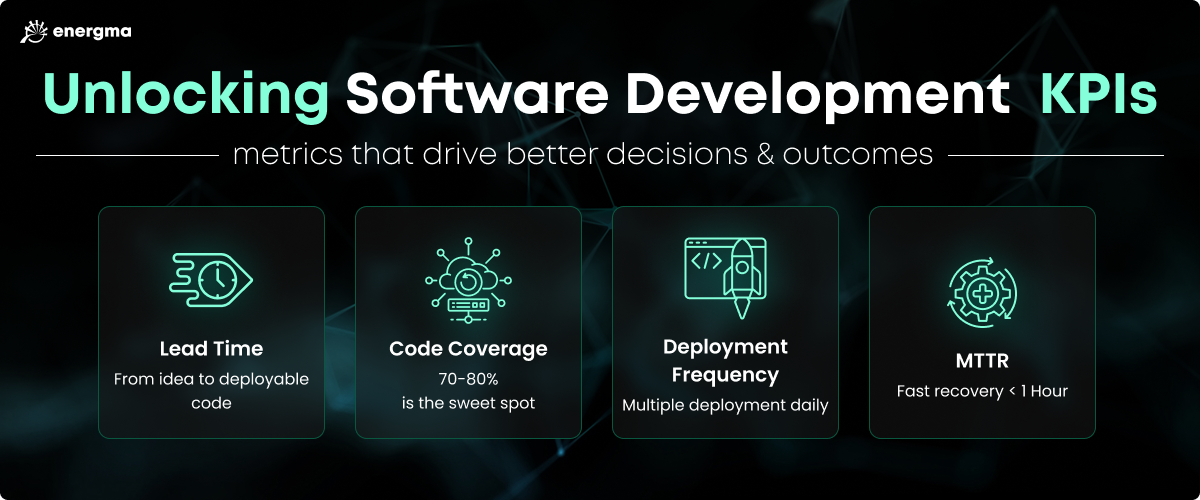
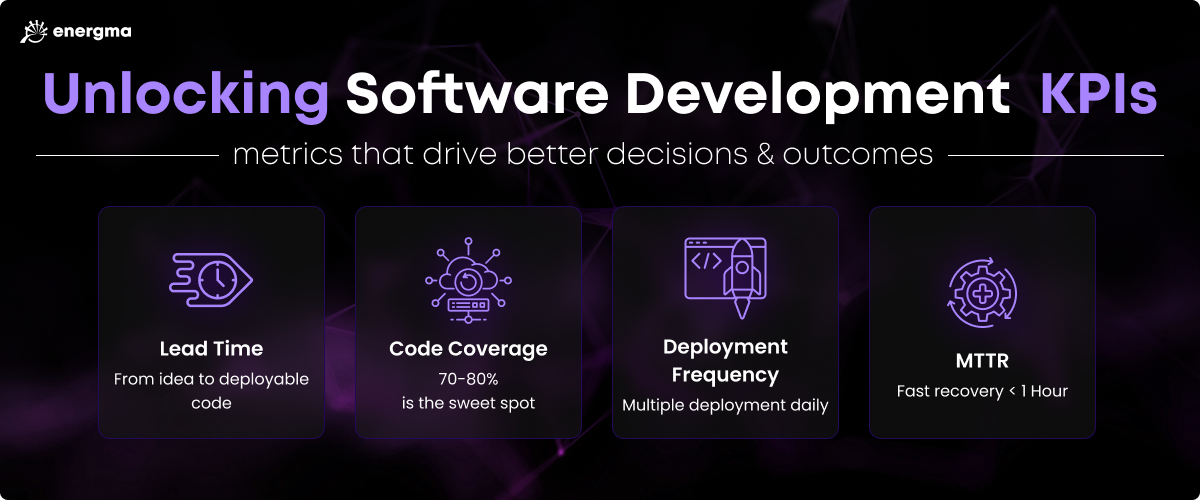
  • Lead Time shows how fast ideas become deployable code. Shorter lead times mean faster feedback, happier users, and higher morale.
  • Code Coverage of 70–80% is healthy; 100% is wasteful. Focus on meaningful tests.
  • Strong documentation is your long-term advantage and the pillar of organizational knowledge.
  • Elite teams deploy several times a day, recover hourly, and fail gracefully. The goal isn’t zero failures, but rapid detection, learning, and recovery.

Efficiency and Productivity KPIs

We’re breaking this list of 15 software development KPIs into three categories, starting with the most traditional set of software metrics – the classics that focus on productivity and efficiency in the development process.

Lead Time

Lead time measures how long it takes from the moment a task is requested to the production-ready code. This KPI covers every stage: requirements, coding, testing, and deployment. In short, it reveals how efficiently your team moves from concept to delivery.

What you need to know:

  • Shorter lead times mean faster releases, happier users, and higher momentum.
  • Long lead times expose bottlenecks — broken handoffs, unclear specs, or burnout that slowly drains team morale.

While overall lead time gives you a high-level view of performance, it’s an early warning system. Use it as your signal, then dig deeper into other metrics to pinpoint specific process inefficiencies.
Blog image

Branch Creation to Merge Time

Branch-to-merge time tracks how long it takes for new code to make it from a feature branch into the main branch. It’s the clearest view into your team’s raw development speed. Unlike lead time, this KPI isolates the build phase. Requirements, testing, and deployment don’t count here. It’s one of the strongest predictors of sustained engineering velocity.

What you need to know:

  • Long merge times expose pull requests sitting idle, reviews delayed, or developers juggling too many priorities.
  • Shorter merge times mean faster feedback loops, cleaner commits, and healthier overall productivity.

Commit to Deploy Time

Commit-to-deploy time measures how long it takes for a developer’s code to go from the moment it’s committed to the moment it hits the production environment. In essence, it measures the time after a new branch is merged. Monitoring commit-to-deploy time helps organizations identify delays in the CI/CD process, such as prolonged build times, extended testing phases, or deployment bottlenecks. When that window stretches, feedback slows and releases stack up.

What you need to know:

  • This metric reveals friction inside the CI/CD pipeline, highlighting areas that may need optimization.
  • Reducing it keeps your release cycle fast and feedback loops tight, so features, fixes, and improvements reach users quickly.

Number of Pull Requests per Week

Pull requests per week measure how often code changes are submitted for review and integration into the main codebase. This KPI is a direct pulse of your development activity. It’s one of the simplest ways to see whether your team’s moving or stalling. A higher number of pull requests indicates a healthy, active development process where team members are regularly contributing. Conversely, a low number of pull requests signal potential roadblocks, resulting in lack of progress.

What you need to know:

  • This KPI tracks how frequently developers submit code for review and integration. It’s the heartbeat of collaboration.
  • Increasing pull request frequency drives faster code reviews, tighter feedback loops, and a culture of continuous iteration.

Code Reviewer Response Time

Code reviewer response time measures how long it takes for a reviewer to respond after a pull request is submitted. It’s a small metric with a massive impact across the entire development cycle. When reviews drag, developers lose flow, feedback is getting slower and context fades. Fast and efficient reviews, on the other hand, keep features shipping, bugs visible and quality high.

What you need to know:

  • Reducing reviewer response time leads to faster integrations, improved code quality, and a more streamlined development process.
  • Some teams also track the number of code reviews completed in a given time period, to spot early workflow bottlenecks.
Code Quality KPIs

While development speed is important, tracking code quality KPIs gives you the other half of the performance picture. The half that keeps customers happy and the team's performance at its best. These quality metrics show whether you’re building software that’s maintainable, reliable, and safe to change. Beware, they’re also leading indicators of future problems.

Code Coverage

Code coverage is one of the essential KPIs for software development. It measures how much of the source code is being checked when you execute automated tests. Of course, the higher the coverage, the more reliable your tests and code become.

For most teams and projects, 70-80% is a healthy target and what you should aim for. Google calls 60% acceptable, 75% commendable, and 90% exemplary. Safety-critical systems often target 90%+ coverage, sometimes by regulation for specific coverage types.

But don’t chase 100%. Some code is hard or meaningless to test. Filling your suite with trivial tests wastes time and breeds confidence. Instead, focus on meaningful coverage. Test critical paths, complex logic, boundary conditions, and code that changes frequently. Use coverage as one quality signal, not as a standalone target. Combine it with other quality indicators like defect density and code churn rate to get the full picture.

Defect Density

Defect density measures bugs found per unit of code, usually expressed as defects per thousand lines of code (KLOC). It’s one of the clearest indicators of software quality and reliability. You calculate it by dividing the number of defects by total lines of code, then multiplying by one thousand. For example, 75 defects in a 100 KLOC system equals a defect density of 0.75.

Benchmarks:

  • Mission-critical systems: 0.1–0.5 defects per KLOC
  • Commercial software: 0.5–1.0 during testing, improving to ~0.3 at release
  • Embedded or real-time systems: 0.05–0.2

Trends matter more than any single number. Track whether your defect density is rising or falling between releases. Many defects trace back to unclear requirements, design flaws, or frequent changes. Find the pattern, and you’ll find the root cause.

Code Churn Rate

Code churn measures how often a team rewrites its own code. It’s calculated by dividing the number of lines added, modified, or deleted by the total lines of code, then expressing that as a percentage. On its own, churn isn’t good or bad. It shows how active your codebase is and where effort is concentrated. The real story lies in the context and timing.

Here are the typical standards for code churn:

  • Below 15%: stable, efficient teams
  • 15–25%: healthy iteration range
  • Above 25%: warning sign

High churn is normal in new projects or during big refactors. Sustained high churn after the first release, especially in the same modules, is a red flag. That often points to unclear requirements, poor design decisions, or code that’s difficult to maintain.

Use churn to pinpoint trouble spots. Look for files or components that keep changing, and compare churn against your defect data:

  • High churn + many defects = quality problems
  • High churn + few defects = improvement in progress
  • Low churn + more bugs = stagnation, rising technical debt

Your goal shouldn’t be zero churn. In fact, that’s a myth. However, when churn stays high without reason, you’re not improving, you’re redoing. Track it to see where your codebase needs attention and where your team’s effort improves quality.

Technical Debt Ratio

Technical Debt Ratio (TDR) measures how much effort it would take to fix code issues compared to the effort it took to build the product.

Formula: (Remediation Time ÷ Development Time) × 100

  • This KPI tracks how frequently developers submit code for review and integration. It’s the heartbeat of collaboration.
  • Increasing pull request frequency drives faster code reviews, tighter feedback loops, and a culture of continuous iteration.

There is no single perfect number for this metric, but there’s always a threshold. Most healthy teams keep their TDR between 5% and 10%, maintaining strong delivery speed and code quality. However, once the ratio crosses 20%, it signals deeper issues that need attention and planning.

Context also matters. Startups building quickly can live with higher ratios while chasing growth. Mature products benefit from keeping debt lower to protect stability and long-term performance. To manage TDR effectively:

  • Track it with tools like SonarQube or CodeClimate
  • Review trends, instead of snapshots
  • Link cleanup to sprint goals and roadmap planning
  • Balance new features with systematic refactoring

Technical debt will always exist, and is not an enemy. Neglect is. Plan debt cleanup into your normal sprints. The goal is controlled debt, not zero. When you treat debt reduction as ongoing maintenance, you keep your codebase healthy and predictable.

Code Security

Code security measures how well your code resists unauthorized access, data leaks, and vulnerabilities that can be exploited. One overlooked dependency or unpatched library is all it takes for attackers to find a way in. And once they do, the fallout isn’t technical. It’s trust in your product and reputation.

Code security keeps sensitive data confidential everywhere it counts. Access controls, encryption, and regular code audits aren’t checklists. They’re security habits baked into every commit to prevent breaches, data theft and other malicious activities. By implementing those, developers can create a formidable barrier against cyber threats.

Moreover, secure code is a prerequisite for compliance. Industries under compliance pressure (finance, healthcare, government) have zero tolerance for weak links. Adherence to these standards not only avoids potential legal penalties but also signals to customers that the software is reliable and safe to use.

Documentation Quality

Quality code documentation is an essential aspect of software development that serves as a comprehensive manual for the codebase. It provides developers with a clear and detailed description of the software’s functionality, architecture, and dependencies. It’s the blueprint that keeps your codebase alive long after the original authors move on.

When written right, good documentation can significantly slash onboarding time for new developers and close the knowledge gap between team members.

Blog image

For businesses, high-quality code documentation is a game-changer. It ensures that the technical details and complexities of the software are accessible and understandable. Proper documentation facilitates smoother transitions when team members change, as the knowledge is preserved and transferable.

Deployment and Reliability Metrics (DORA Metrics)

DORA metrics are the four pillars to modern DevOps performance: speed, stability, and responsiveness. Think of them as your engineering dashboard. Two metrics show throughput, while two measure stability. These four indicators act as both leading and lagging signals. Leading metrics show where performance is heading while lagging ones reflect past performance and outcomes. Together, they reveal whether your pipeline is a bottleneck or a performance engine.

Change Lead Time

Change Lead Time measures the time it takes from the first commit through active coding, review, editing and release to production. Specifically, it’s the most useful for understanding coding productivity. It’s narrower than total lead time because it focuses only on the time after development starts.

Elite teams consistently ship changes in less than a day. High performers average less than a week. Low performers can take months. The difference usually comes down to automation, pipeline efficiency, and how teams manage approvals and handoffs. Short lead times let you react quickly to new requirements and bugs. When you can deploy a fix within hours, you stay close to customer needs and ahead of competitors.

To shorten lead time for changes:

  • Automate deployments
  • Remove unnecessary manual approvals
  • Break large features into smaller deployable units
  • Improve test reliability

Fast, confident delivery depends on smooth automation and smart process design. The goal is not speed alone, but confidence in every release.

Deployment Frequency

This metric measures how often application changes are deployed to production. The higher the frequency, the more responsive and efficient your delivery process becomes. It’s one of the clearest signs of how fast you can deliver value.

According to the 2024 DORA report:

  • Elite teams deploy several times a day
  • High performers deploy daily or weekly
  • Medium performers deploy once or twice a month
  • Low performers release less than once a month

Higher deployment frequency usually leads to better project outcomes. Teams that deploy often make smaller, safer changes. They catch issues faster and learn from user feedback sooner. In contrast, slow cycles delay learning and increase the risk that changes pile up.

To increase deployment frequency:

  • Automate your testing and release process
  • Using continuous integration and continuous delivery (CI/CD) pipelines
  • Manage infrastructure as code to cut manual steps
  • Keep pull requests small and review cycles short

Automation has made frequent deployment the new standard. Most teams now automate a large share of DevOps tasks. But again, speed alone isn’t the goal. The best teams release often while keeping quality high and change failure rates low.

Change Failure Rate

Alongside deployment frequency, change failure rate (CFR) is one of the most widely tracked engineering metrics. And for a good reason. It tracks how often deployments cause failures in production. It's a key indicator of code quality and reliability. What makes CFR so valuable is its objective. Either your deployment broke something, or it didn't. Unlike subjective quality metrics, CFR gives you a concrete measure of how stable your code is.

Generally, elite performers maintain a CFR of 0-10%. High performers fall between 11-22%, while low performers exceed failure rates of 23%. Low failure rates don’t just mean fewer outages. They reflect better testing, cleaner requirements, and disciplined processes.

To lower change failure rate:

  • Improve automated test coverage
  • Use feature flags for safer rollouts
  • Mirror tests in staging environments and production
  • Run automated integration tests on every release
  • Hold post-incident reviews to find and fix root causes

The goal is not to eliminate all failures, that’s impossible. Deploy often, detect fast and recover faster. Robust QA processes, gradual rollouts, orchestration tools, and redundant safeguards are prerequisites to keep production stable and low production failure rates.

Mean Time to Recovery (MTTR)

If CFR looked at how often systems break, MTTR reveals how long it will take to get things back on track. In other words, mean time to recovery calculates the average time it takes your team to restore services after an unexpected incident. It’s a direct look at how resilient your systems are and how effective your response is.

If we look back again at the 2024 DORA report:

  • Elite teams recover in less than one hour
  • High performers take less than a day
  • Low performers can take months

The difference comes from visibility, automation, and how prepared the team is when things go wrong. Fast recovery limits the impact on customers and keeps your business operations running. The faster you fix a production issue, the smaller the damage.

You can improve MTTR with real-time monitoring and alerts. Also, enable automated rollback for failed deployments. Treat every incident as a learning opportunity, and make sure to have concrete incident management procedures in place.

Tips for Implementing and Using Software Engineering KPIs Effectively

Simply tracking KPIs won’t translate to improvements. Implementing and using them will. It requires careful planning, communication, and a commitment to continuous improvement. Here are some of the best practices to get the most value:

● Define clear objectives: Every KPI needs a purpose. Tie each one to a specific business or engineering outcome. If goals are vague, teams don’t understand what they’re aiming for and leaders can’t properly assess progress.

● Implement a mix of leading and lagging indicators: Incorporate both indicators to get a comprehensive overview and anticipate future trends.

● Establish baselines and targets: Establish baseline values for each KPI first, then set realistic targets based on historical data, industry standards, and objectives to provide clear direction and motivation for improvements.

● Provide regular feedback: Review metrics regularly and make it visible to stakeholders. Use KPI data to hold individuals and teams accountable for their performance and outcomes, promoting a culture of transparency.

● Collaboration over control: KPIs should work with your team, not against them. Frame them as tools for support and personal growth, not surveillance. Encourage the sharing of insights, lessons learned, and best practices related to KPI performance to facilitate organizational knowledge and improvement.

● Choose the right KPI tools: Spreadsheets and manual tracking processes don’t scale. Use engineering intelligence platforms that surface insights, connect existing tools, and contextualize trends.

Conclusion

The 15 KPIs in this guide give you a complete framework to measure and improve both efficiency and productivity. When you track the right metrics, set benchmarks, and act on what they reveal, you create a more effective engineering organization — one that delivers quality software at speed.

But metrics without people can’t move teams. The goal isn’t to chase isolated numbers, but to create a balanced, high-trust culture where developers thrive and users get value fast. With the right KPIs and a thoughtful approach to improvement, you can achieve both objectives and lead your team to sustained success.

Looking to sharpen your delivery systems and maximize your team’s efficiency? Start with a software development audit. Our experts will help you identify improvement areas, optimize workflows, and align your KPIs with real business outcomes.

Contact us today to turn insight into measurable success.

Table of Contents

  • Efficiency and Productivity KPIs
    • Lead Time
    • Branch Creation to Merge Time
    • Commit to Deploy Time
    • Number of Pull Requests per Week
    • Code Reviewer Response Time
  • Code Quality KPIs
    • Code Coverage
    • Defect Density
    • Code Churn Rate
    • Technical Debt Ratio
    • Code Security
    • Documentation Quality
  • Deployment and Reliability Metrics (DORA Metrics)
    • Change Lead Time
    • Deployment Frequency
    • Change Failure Rate
    • Mean Time to Recovery (MTTR)
  • Tips for Implementing and Using Software Engineering KPIs Effectively
  • Conclusion