• What we do

    Full Cycle DevelopmentIT Staff AugmentationAI DevelopmentEnterprise Application DevelopmentTechnology ConsultingVenture Studio

    What if...

    You are Founder?You are Investor?
    Service Preview
    Service preview

    Full Cycle Development

    End-to-end software development from concept to deployment, using cutting-edge technologies and best practices.

    Learn more
  • Blog
    Move Fast, Keep Your Equity: Energma's Venture Studio ModelStop Leaking Data and Budget: Local LLM Setup in 20 MinutesAutomate your workflow with Atlassian and Claude CLIClaude Code: Installation & Basic Usage GuideContainerizing Node.js Microservices with Docker & Kubernetes
    Company News
    A Sharper Bound: New q-Berezin Radius ResultsThe Newest q-Berezin Radius Results: A Discipline of Getting It RightBuilt Around Your Privacy: Citadel Auth 1.0 Is Now LiveYour Device, Your Rules: Introducing Citadel Auth 2FABridging Technical Excellence: Theoretical Mathematics and Software Engineering
    Case Studies
    The New Blueprint: AI-Driven Mortgage EngagementOne Hub. Unified Fintech Control.From Static to Addictive: Content Exchange PlatformMeetings, Transformed: Gesture-Led WorkspaceOperations, Synced: End-to-End Live Process Monitoring
    Featured resource
    Featured article

    The New Blueprint: AI-Driven Mortgage Engagement

    Rebuilt outdated systems and UX to boost performance, accelerate feature delivery, and simplify integrations for a leading real estate tech platform.

    Read more
    See all case studies
  • About Us
  • FAQ
Get Started

We deliver advantage beyond features.
What will you ship?

Get Started
  • Full Cycle Development
  • IT Staff Augmentation
  • AI Development
  • Enterprise Application Development
  • Technology Consulting
  • Venture Studio
  • Case Studies
  • Blog
  • Company news
  • About
  • FAQ
  • Contact Us

Follow Us

Site MapTerms of UsePrivacy Policy
© Energmа 2026. All rights reserved.
Železnička 94, 11300 Smederevo, Serbia

Cookie Preferences

We use cookies to enhance your browsing experience, serve personalized content, and analyze our traffic. Choose your preferences below.

Essential Cookies

These cookies are necessary for the website to function properly. It is accepted by default.

Always On

Analytics Cookies

These cookies help us understand how visitors interact with our website by collecting and reporting information anonymously.

Marketing Cookies

These cookies are used to track visitors across websites to display relevant advertisements.

Back to blog
← Back to blog
Article thumbnailArticle thumbnail

Move Fast, Keep Your Equity: Energma's Venture Studio Model

You've got the insight. You might even have the capital. What you don't have is 6-12 months to find a technical co-founder and ship an MVP, or the budget to cover the mistakes that happen along the way. The data backs it up: founders building alone average close to 5 years to reach Series A. Studio-backed ventures do it in roughly half that time.

Closing that gap is the point. Whether you're a founder launching something entirely new, or a business leader investing in what's next inside a company that already works, the problem is the same: good ideas need engineering firepower faster than most people can build or hire for it.

Quick Summary

  • Studio-backed startups reach Series A in roughly half the time of solo-founder companies, with meaningfully higher seed funding and exit rates across the industry.
  • Energma's Venture Studio runs two tracks: build a brand-new venture with an outside founder or fund a new product line inside a company that already exists.
  • Unlike a VC fund, which writes a check and waits for a return, a studio operates as your technical co-founder involved in architecture, code, UX, and infrastructure from the very first day.
  • Across the industry, studio deals typically take one of three forms: equity-for-build, fee-for-build, or a hybrid of both.
  • The real payoff, alongside speed, is the product built right the first time, before shortcuts become the technical debt you're still paying down.

Why Good Ideas Die Before They Ship

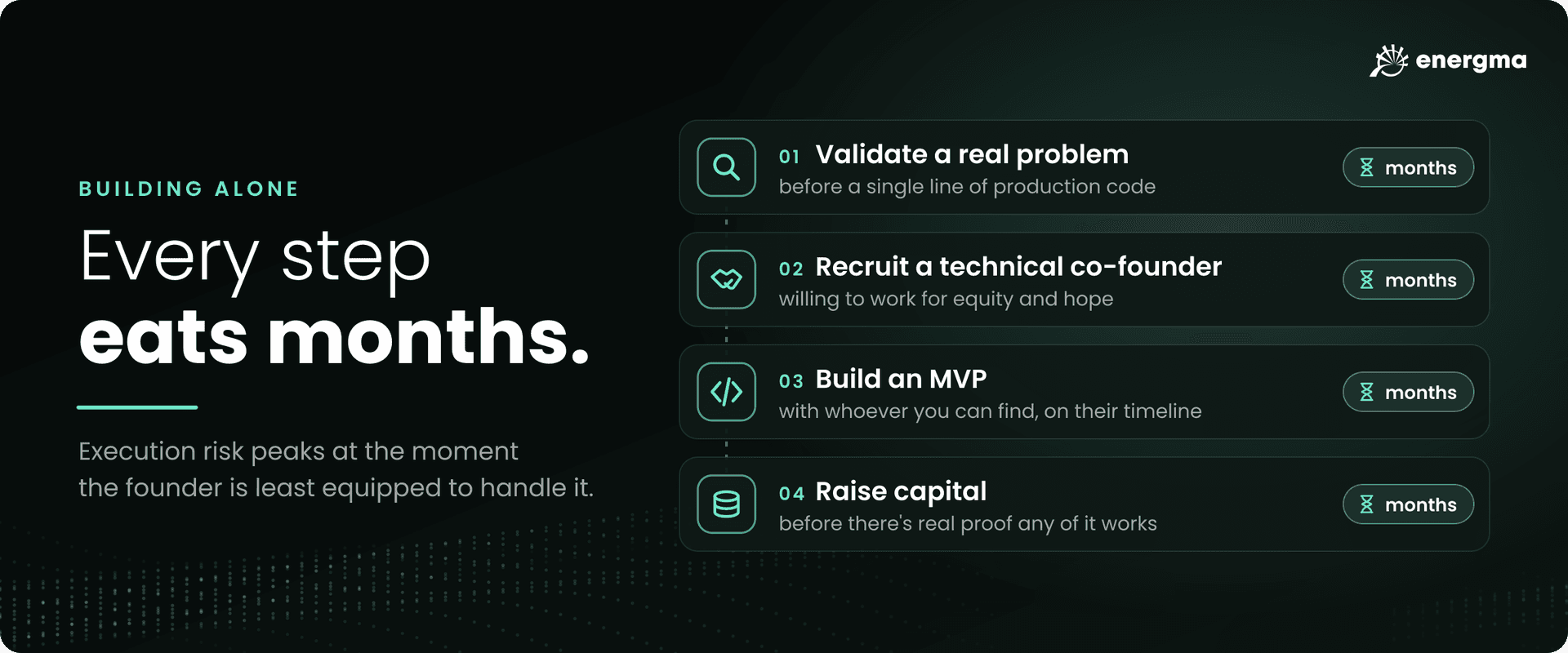
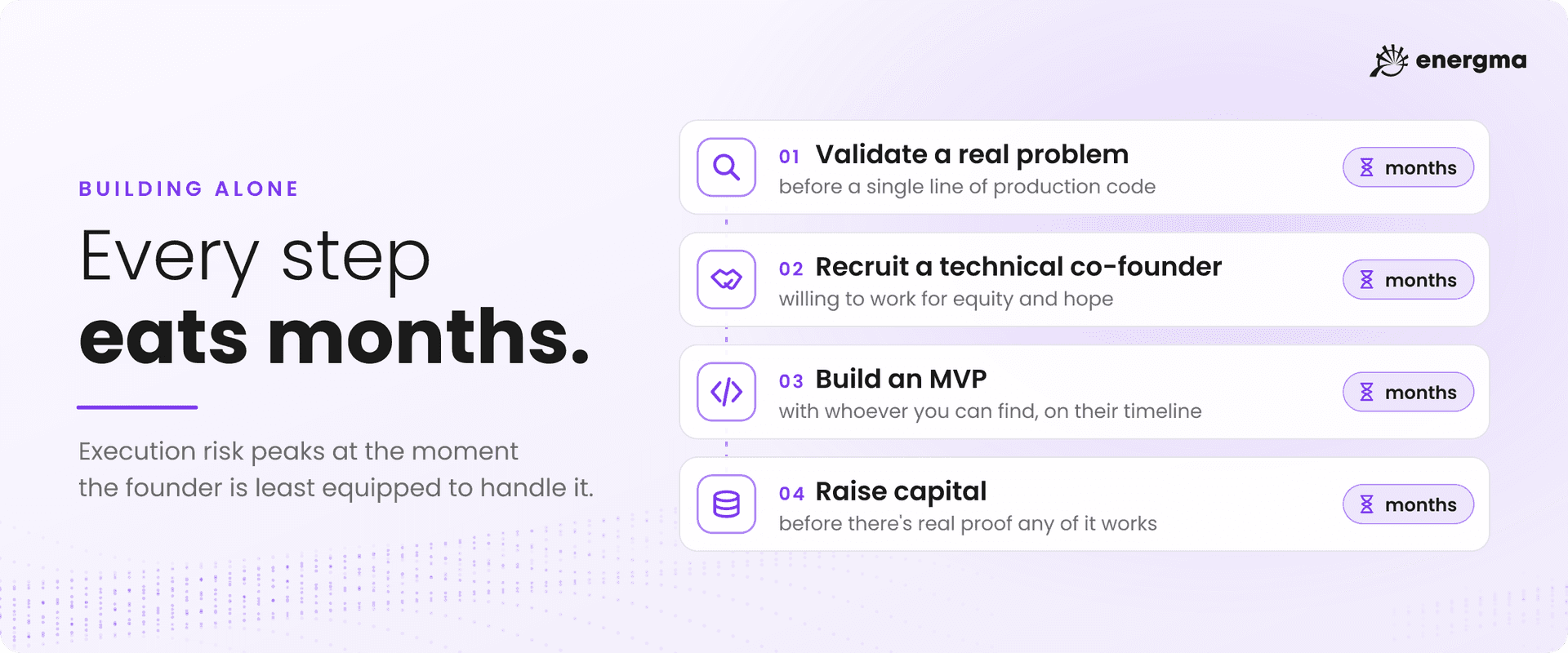
Here's the uncomfortable truth: the idea wasn’t weak. The failure happened because execution risk peaks at the moment the founder is least equipped to handle it. Think about what a solo founder has to do before writing a single line of production code. Validate a real problem. Recruit a technical co-founder willing to work for equity and hope. Build an MVP with whoever they can find on whatever timeline that person has available. Raise capital before there's real proof any of it works. Every one of those steps eats months.
Blog imageBlog image

The riskiest, most technically demanding phase of a company's life happens before the company has the engineering and business muscle to handle it. Corners get cut because they have to be. Frameworks get chosen for speed, not scale. Six months later, "we'll fix it after launch" quietly becomes eighteen months of technical debt nobody budgeted time or money to pay down.

A venture studio exists to remove that gap entirely, bringing senior operators and engineers to the exact moment most companies have the least of it.
What Is a Venture Studio?

A venture studio, sometimes called a startup studio or venture builder, is an organization built to create companies, not just fund them. Instead of writing a check and waiting for a founder to figure the rest out, the studio operates as an embedded co-founder: generating or refining the idea, validating demand, building the actual product, and staying inside the business until it's strong enough to run on its own.

That's the distinction that trips people up. A venture studio isn't a mentorship program, and it isn't a passive investor watching from a board seat. It's a builder that happens to also bring capital and structure to the table. The studio takes on execution risk, while the founder or business brings the market insight and vision. The model has been around longer than most people assume. It traces back to the mid-1990s, when the first studios proved that a diversified portfolio of internally generated companies could survive market downturns that wiped out singularly focused founders. 30 years later, the core insight hasn't changed: building alongside experienced operators beats building alone, especially in the twelve months that decide whether a company survives its own infancy.

Who This Is For

Not every founder needs a studio, and not every studio fits every founder. This model is mostly built for:

  • Aspiring founders with domain expertise but no technical co-founder - You know the problem. You don't want to spend a year finding someone who can build the solution, and you don't want your first hire on a stranger's LinkedIn profile.
  • Founder-investors - You've got capital and conviction, and you'd rather buy execution outright.
  • Business leaders launching a new product line - You run a company that already works. You want to test something new (a feature, a spin-off product, a new market), without diverting your core engineering team from the roadmap that's already generating revenue.
  • Corporate innovation and spin-out teams - You need to move at startup speed inside a structure that was never built for it.

What connects all four reflects the same underlying constraint: a valuable idea but too few engineering hours to build it in-house within the opportunity's timeframe. The studio model exists specifically to solve that constraint, regardless of which side of the cap table you're sitting on.

How a Studio Differs From a VC, Accelerator, or Incubator?

Where four models compete for the same conversation, founders tend to confuse them. Here's the difference, side by side:

ModelWhen They Show UpWhat They Actually DoTypical Stake
Venture StudioIdea stage, sometimes before the idea fully exists.Generates or validates ideas, builds the MVP, recruits the team, stays hands-on through launch20% – 60%
IncubatorEarliest concept phaseMentorship, workspace, light guidance0% – 10%
AcceleratorMVP or early traction, fixed 2 – 4 months cohortMentorship, network access, capital injection to prep for fundraising5% – 10%
Venture CapitalPost-traction, growth stageEpisodic involvement with capital, board seats and strategic advice15% – 25%

The pattern holds across every version of this comparison you'll find: the earlier a model shows up, the more operational it is. Studios sit at the far end of that spectrum, sometimes even before day zero, when the "idea" is still a hunch a founder hasn't fully articulated yet.

The Investment Model: Industry Norms vs. How We Operate

Every venture studio guide will tell you equity is the default: the studio takes a stake, usually somewhere between 20% and 60%, in exchange for building the company from scratch. For an outside founder with a strong idea and limited capital, that's often how the conversation starts. But leaving that much equity on the table can hinder you later, limiting future fundraising and leaving less room at the exit.

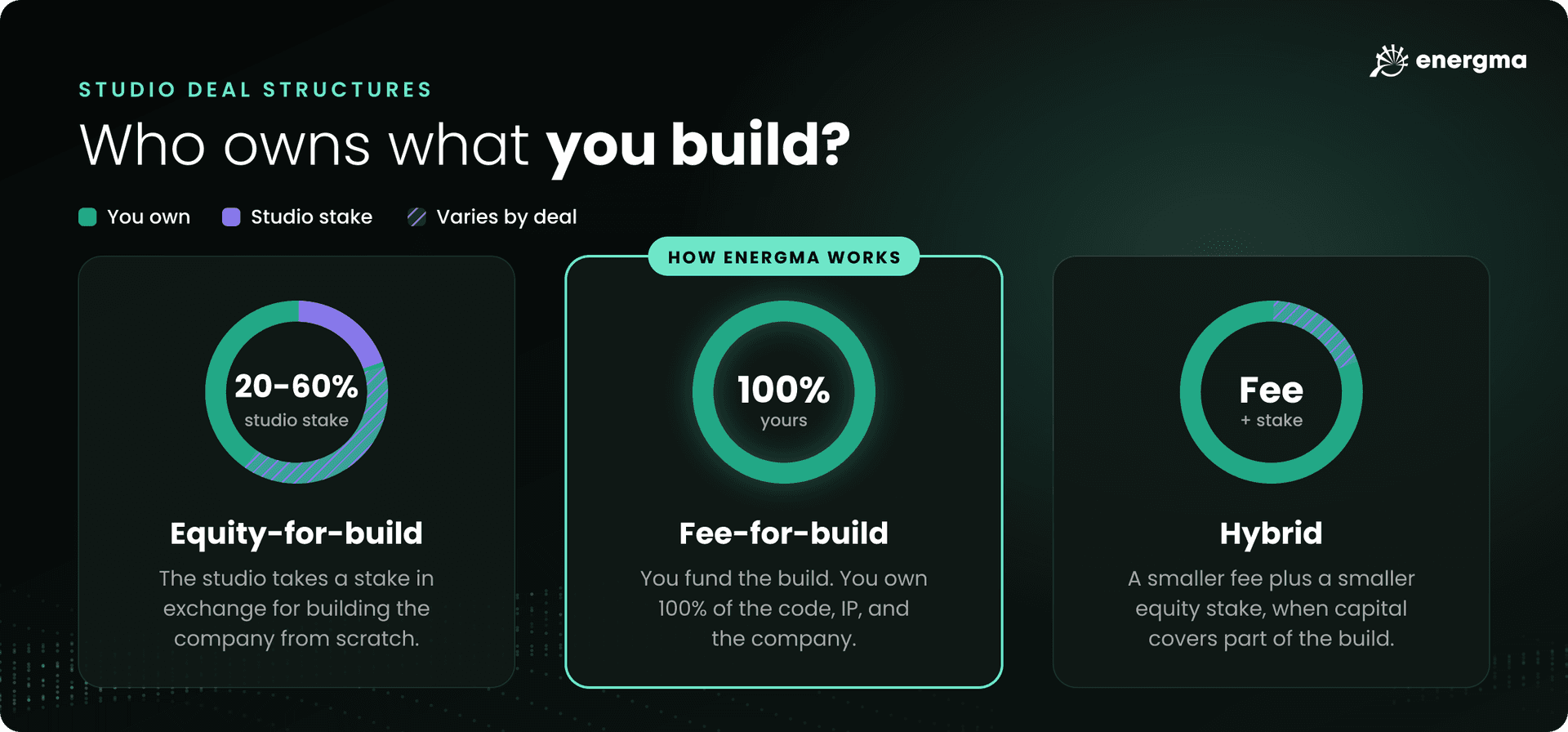
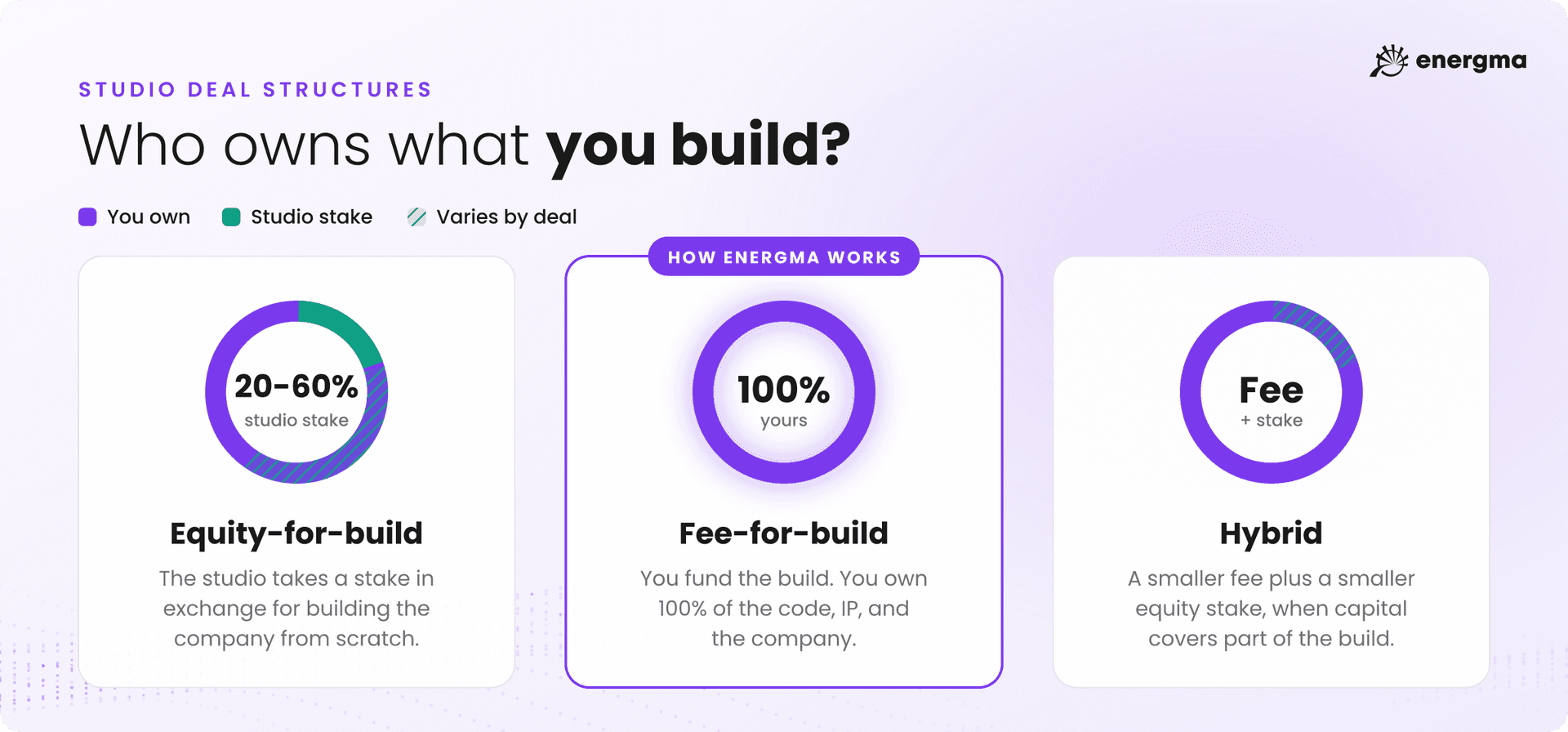
Across the industry, studio deals typically land in one of three structures:

  • Equity-for-build - the studio takes a stake, usually 20-60%, in exchange for building the company from scratch. Most common for outside founders with an idea and limited capital of their own.
  • Fee-for-build - the client funds the build directly and retains full ownership. Most common for companies investing their own capital into a new product or feature.
  • Hybrid - a smaller fee plus a smaller equity stake, used when a founder has some capital but not quite enough to fully fund the build alone.
Blog imageBlog image

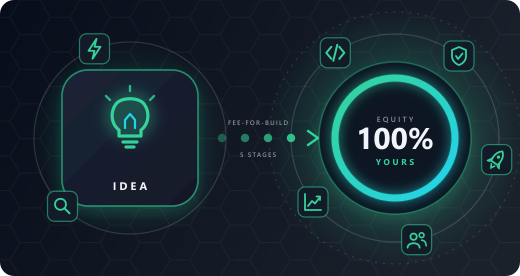
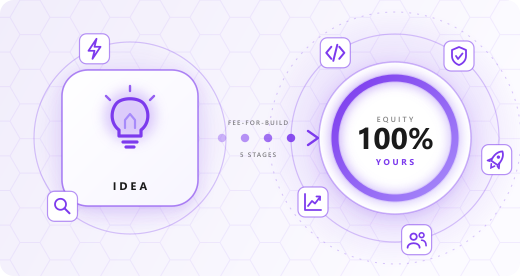
Most studios build the cap table around their own return. Energma builds around yours, which is why we only operate in one of those three lanes: fee-for-build, every time. We don't take equity. Not from outside founders, not from existing companies, not under any version of this engagement. You fund the build. You own 100% of the code, IP, and the company.

That holds whether you're an outside founder with a strong idea and no technical team of your own, or an existing company investing $80K into a new product line or a feature that could eventually spin out on its own. The door you walk through changes who's funding the build. It never changes who owns it.

Here's what that looks like in practice:

  • For outside founders - you bring the idea and the funding, whether that's your own capital, raised capital, or a mix. We bring the engineering team and the execution. You walk away owning your company outright, without dilution.
  • For existing companies - you invest capital into a new product line or feature. We build it to the same standard as everything else in your stack. It's your asset the moment it ships, same as if you'd hired the team in-house, except faster, and without the hiring risk.

The Numbers Behind the Model

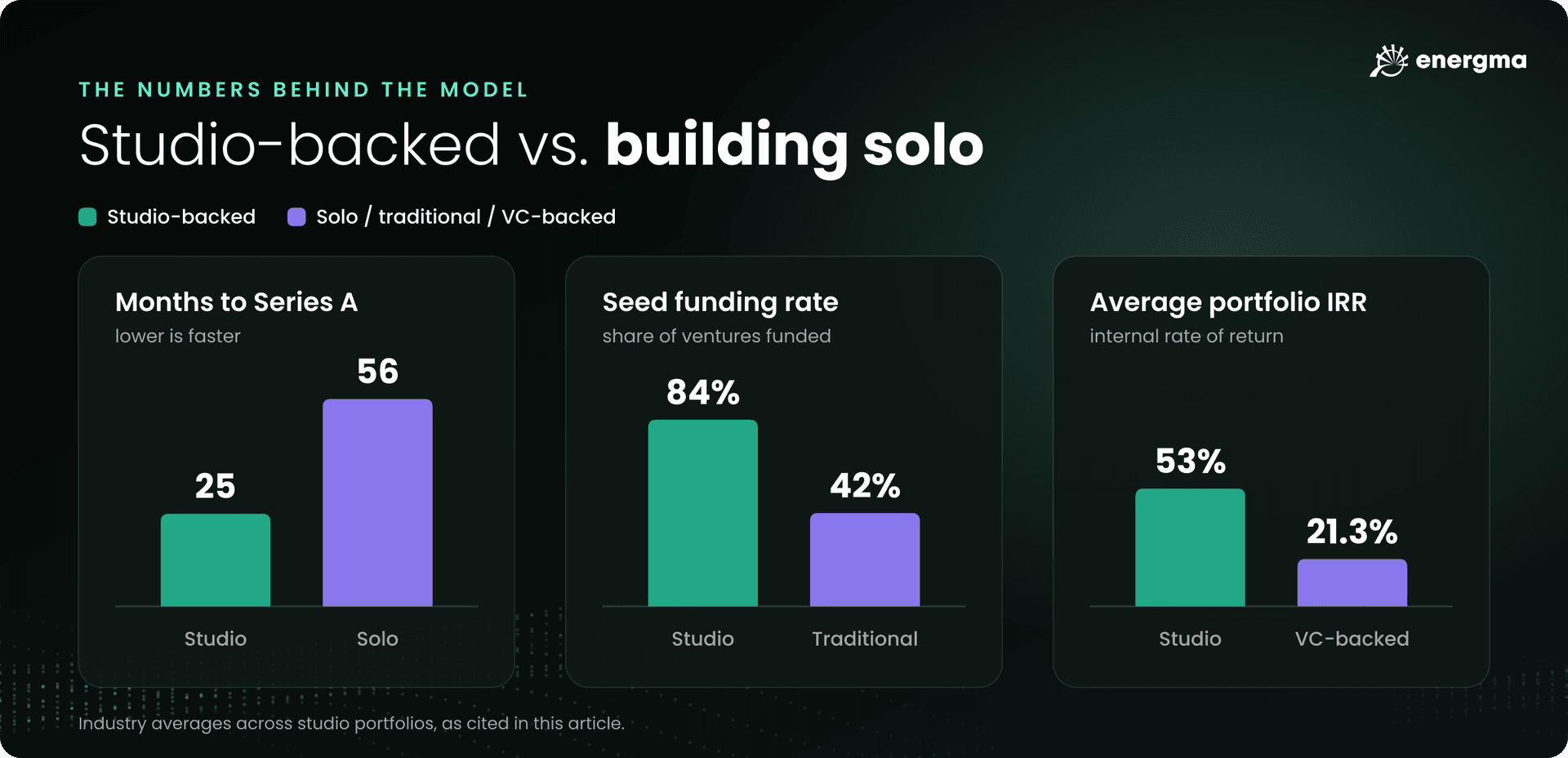
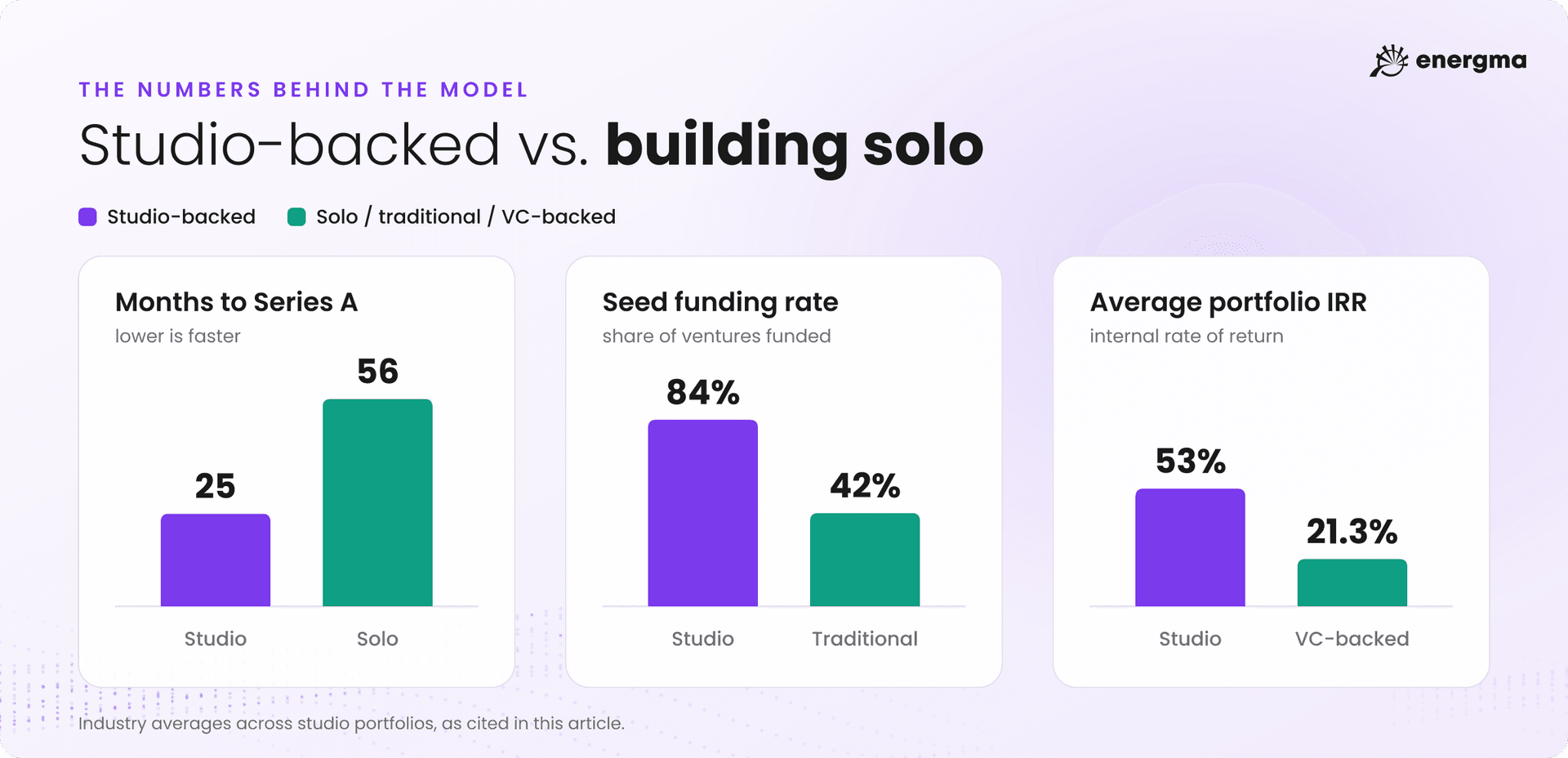
The venture studio model is backed by a growing body of data across the industry. They're patterns observed across studio portfolios broadly, and they're worth knowing before you evaluate any partner:

  • Studio-backed startups reach Series A in roughly 25 months, compared to 56 months for founders building solo.
  • Seed funding rates for studio ventures run as high as 84%, against roughly 42% for traditional startups.
  • Reported internal rates of return for studio portfolios average around 53%, compared to 21.3% for conventional VC-backed companies.
  • Studio startups reach acquisition roughly 33% faster and IPO about 31% faster than their non-studio counterparts.
  • Seed funding rates for studio-backed ventures run close to double that of independently raised startups.
Blog imageBlog image

Worth being honest about the other side, too: an estimated 70% of venture studios themselves fail. Usually from an undefined niche, bloated founder deals, or equity asks large enough to choke future funding rounds before they start. The model works, but the operator matters just as much as the model does. That's the part most comparisons skip.

What to Look for in a Venture Studio Partner

Before you hand over equity, a fee, or both, ask the questions that actually separate a real studio from a mentorship program:

  • What have they actually shipped, not advised or consulted on?
  • What's the equity or fee structure and does it scale sensibly with the size of the investment you're making?
  • How involved are they day-to-day?
  • Can they run a brand-new venture and a new product line inside an existing company - or only one?
  • What happens to your technical foundation the day the engagement ends?

Our answer to all five is the same, because we're an engineering company first and a studio second. While the model changes how we engage, it doesn't change our standard: architecture, ownership, and code you can hand to any future team. If you want a second opinion on your budget or scope before committing to any partner, our guide on planning a software development budget is a useful gut-check either way.

How Energma's Venture Studio Works

We built this model because we already run the engineering discipline it requires - the same architecture rigor, clean-code standards, and delivery speed behind every full cycle development engagement we run for existing enterprises.

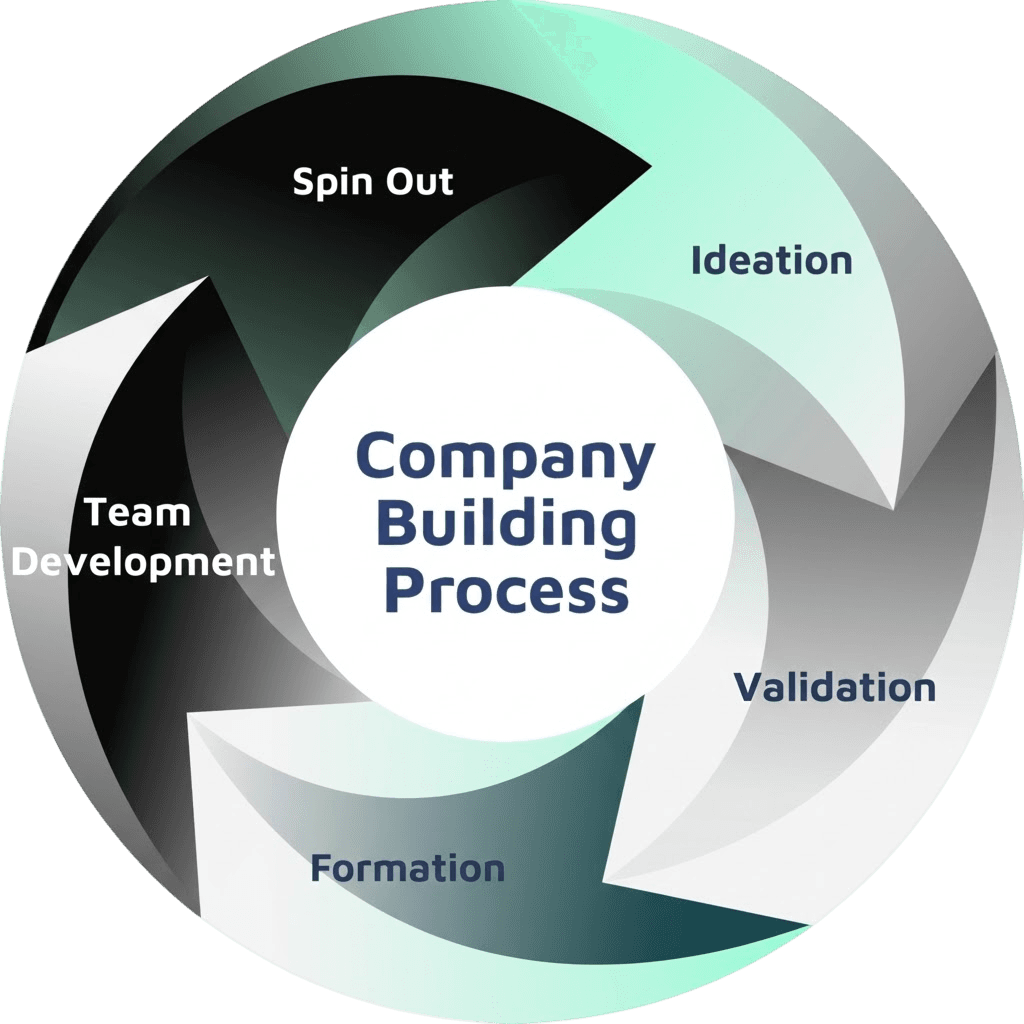
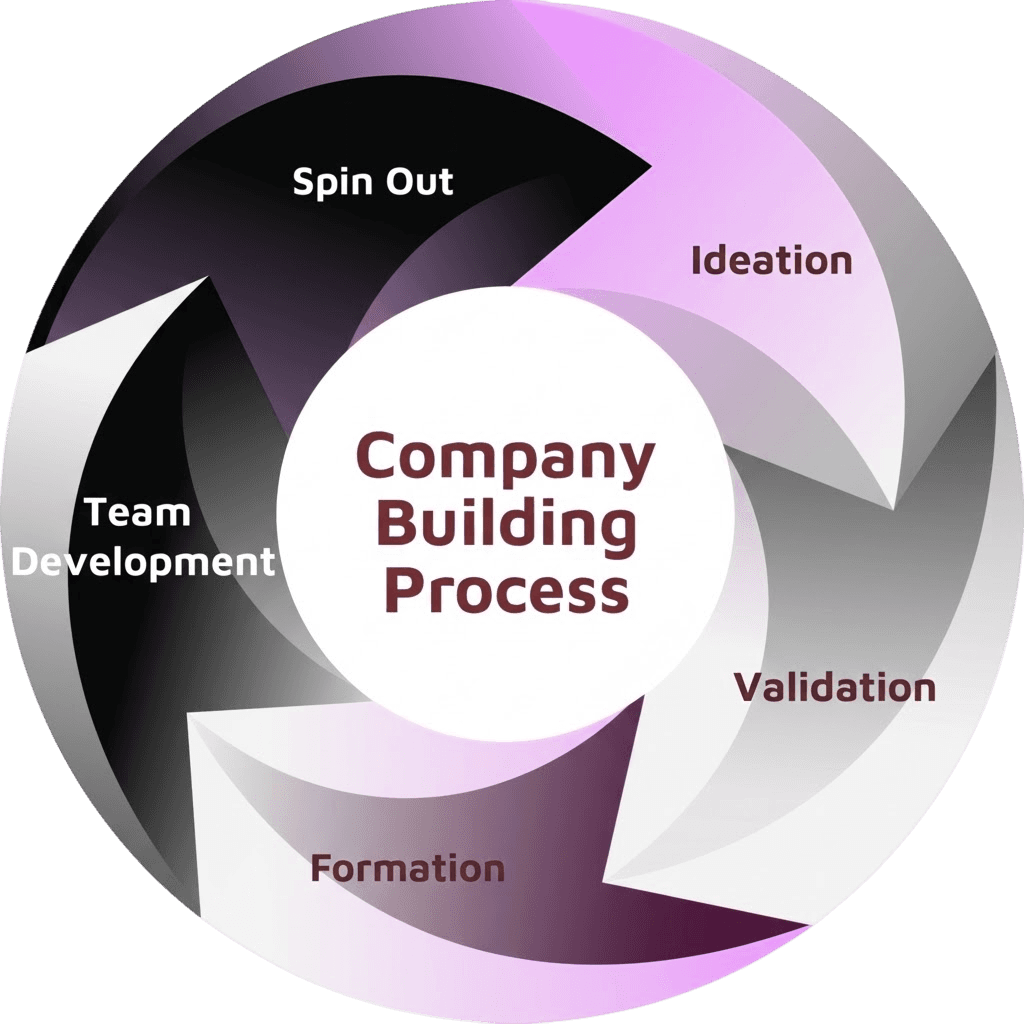
The process runs in five stages:

1. Ideation. Most engagements start with an idea that's already yours - the insight, the domain expertise, the sense that nobody's building this right yet. Our job at this stage is to sharpen it by scoping the real problem, mapping what's already out there, and shaping a raw concept into something specific enough.

2. Validation. Before we write a line of code, we pressure-test the idea: market sizing, technical feasibility, and a documented read on whether this is actually worth building. Ideas that don't hold up get killed here, before they drain 6 months' worth of time and budget.

3. Formation. Once validated, our engineers and product owners design the system the way we'd want to inherit it ourselves: clean, documented, and built to scale. We ship a real MVP without shortcuts.

4. Team Development. Whether it's an outside founder building a company for the first time or an existing company absorbing a new product line, this is where the people side gets built out, the engineering bench, QA, workflows, PMs and operations needed to actually run what's been built.

5. Spin Out. The product goes to market with real users, feedback loops, and a technical foundation that handles iteration without falling over the first time it’s pressured. If it's an independent venture, this is where it stands on its own, built to bring in outside capital and additional talent without a rebuild. If it's a new product line inside an existing company, this is where it becomes just another well-built asset in your stack.

Blog imageBlog image

Two Paths, One Studio

Most venture studio content assumes one scenario: an outside founder with an idea and no team. That's real and we build for it, but it's not the only door into this model. Say your company already exists, already generates revenue, and you want to invest capital, $80K - $200K, whatever the scope calls for, into a new product line or a standalone feature that could eventually become its own thing. You don't need a new legal entity. You don't need to give up equity in the business you already built. You need engineering firepower applied, without pulling your core team off the roadmap that's already working.

Our studio runs both tracks under the exact same process:

  • New Venture - an outside founder, technical or not, partners with us to go from idea to shipped, fundable product.
  • New Product Line - an existing company invests capital into building something new inside the business it already runs.

What You Get When You Build with a Studio

Speed is the headline benefit, but it's far from the whole story:

  • Senior engineering without the hiring overhead.
  • Clean architecture from day one. The technical debt most startups spend years unwinding gets designed out before it ever exists.
  • Flexible engagement structured around your actual situation instead of being forced into a template that doesn't fit.
  • Compounding execution. Every pattern, tool, and lesson from one build strengthens the next. The discipline is reusable, and every venture can inherit something from it.
  • Proof, not promises. It's the same production systems running in the real world, not case studies on a slide.

Build What's Next

Whether you're a founder with a vision and no technical team behind it, or a business leader ready to invest in your company's next product, our venture studio is built to take you from idea to shipped without months of detours most people expect. If you already know exactly what you're building and just need to plan the execution, start with our KPI framework for keeping software projects on track. Keep in mind there's no single "right" entry point. Some conversations start with a napkin sketch and no team. Others are with a line item in next quarter's budget and a feature that's been sitting in the backlog for a year. Both should end the same way with a working product, built clean, owned by the people who should own it. If that's the build you're sitting on, let’s talk.

Table of Contents

  • Why Good Ideas Die Before They Ship
  • What Is a Venture Studio?
  • Who This Is For
    • How a Studio Differs From a VC, Accelerator, or Incubator?
  • The Investment Model: Industry Norms vs. How We Operate
    • The Numbers Behind the Model
  • What to Look for in a Venture Studio Partner
  • How Energma's Venture Studio Works
    • Two Paths, One Studio
    • What You Get When You Build with a Studio
  • Build What's Next